With McLaren’s Lando Norris becoming the 11th Brit to win the Formula One Title, do you know them all, plus some of their links to British marques and cars in the Museum’s collection?
The world's largest collection of historic British cars


The world's largest collection of historic British cars
McLaren’s Lando Norris has won the 2025 Formula One World Championship ahead of reigning champion, Max Verstappen of Red Bull, and McLaren teammate Oscar Piastri. In 75 years, 11 British drivers have been World Champion with a combined 21 titles, making the UK the most successful nation in the sport. Whilst not all of them were driving for British teams, they all have links to British marques and some to vehicles in the Museum’s collection.
Mike Hawthorn became the first British World Champion in 1958, beating compatriot Stirling Moss by just one point in the final standings. Whilst Hawthorn took the title in the Rosso Corsa of the Scuderia Ferrari, he also had triumphs in British Racing Green, driving the Jaguar D-type to victory at the 1955 24 Hours of Le Mans alongside British co-driver Ivor Bueb.
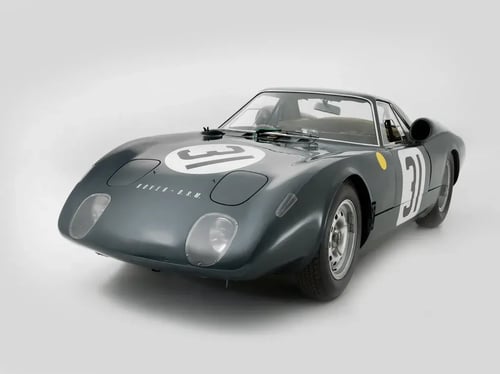
The first British F1 Champion to do it in a British car was 1962 winner Graham Hill driving for British Racing Motors. Outside of F1, BRM worked with Rover on their gas turbine technology, building the Rover-BRM. The car was raced at Le Mans twice, both times with Graham Hill - in 1963 with American co-driver Richie Ginther, and in 1965 with British co-driver Jackie Stewart. Whilst it first ran with number 00 as an experimental entrant, in ‘65 it was a full entry with and finished 10th overall, and 2nd in class. Hill would go on to win his second F1 World Title for Lotus in 1968, following the tragic death of teammate Jim Clark.
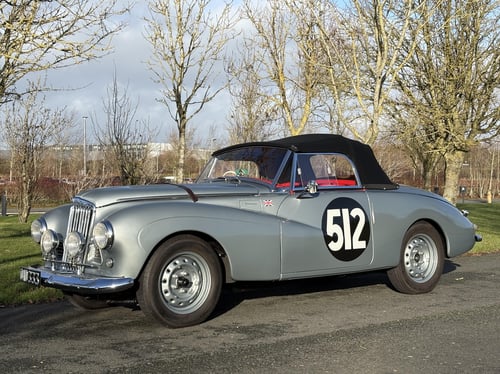
Jim Clark spent his entire F1 career driving for Team Lotus, becoming the first British double champion after winning in 1963 and 1965. Clark had started racing back in 1958 with his own Sunbeam-Talbot 90, given to him by his father for use in rallies and hill climbs in his native Scotland. In the early 1950s, Sunbeam-Talbot saloons had found success in the dangerous Alpine Rally, so Rootes management put into production the Sunbeam Alpine Special, one of which has just been added to the Museum collection. Unlike Clark’s saloon, this is a two-seater drophead coupé, tuned especially for motorsport and it competed in extreme weather conditions at the 1954 Alpine Rally.
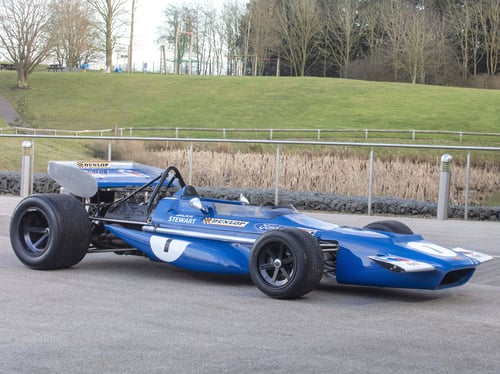
1969 saw Jackie Stewart win his first World Championship, driving for the French team Matra, but powered by the legendary Ford Cosworth DFV engine. For 1970, Stewart was unhappy with Matra’s plan to switch to their own V12, so he and team manager Ken Tyrrell split to form the new Tyrrell Racing Organisation. Tyrrell were initially customers of the equally new March Engineering, using the 701 chassis for Stewart’s title defence, one of which is on display at the Museum. Tyrrell would design their own cars from late 1971 and the choice to stick with Cosworth paid off as Jackie was able to claim the 1971 and 1973 World Championships, becoming the first British triple champion.
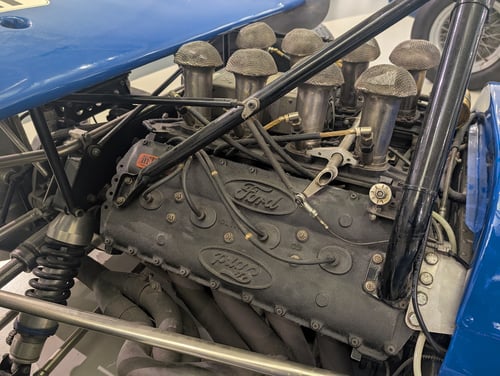
The British built Cosworth DFV was a Ford funded V8 designed by Mike Costin and Keith Duckworth (whose names were combined to create Cosworth). DFV stood for Double Four Valve, as the engine was a development of the earlier four cylinder FVA, which had four valves per cylinder. For many years it was the dominant engine in F1, due to it being affordable, simple, reliable, and powerful. It powered Graham Hill’s Lotus to his second Championship in 1968, and McLaren’s James Hunt to his sole World Title in 1976. Whilst John Surtees had won his title in 1964 for Ferrari, when in 1970 he set up Team Surtees, it was the Ford Cosworth DFV he chose for his cars. It was such a remarkable engine that in 1976, every team on the grid, except Ferrari and Brabham-Alfa Romeo, was powered by Cosworth.
The 1980s was the only decade so far not to feature a British World Champion, with Nigel Mansell coming closest, finishing 2nd in 1986 and 1987 with Williams. After winning the 1977 British Formula Ford Championship, Mansell took the step up to Formula 3, driving a Unipart sponsored, March Triumph 783, much like the one on display at the Museum. Mansell showed his prowess straight away, earning a pole position and a 2nd place finish in his first race. After another 2nd place in the standings in 1991, Mansell would eventually become the 7th British World Champion with the dominant Williams FW14B in 1992.
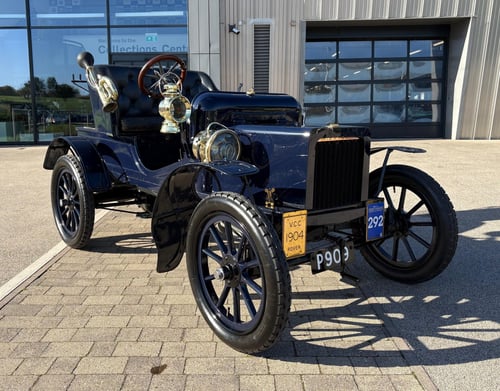
When Damon Hill became World Champion in 1996 with Williams, he became the first son of a World Champion to also win the Championship. Despite winning 22 Grands Prix in his career, it’s not an F1 car we are choosing to highlight here - this car is not only older than Formula 1, but older than Grand Prix racing as a whole! In 2017, Hill and motorcycling TV presenter Charlie Boorman drove our 1904 Rover 8hp at the London to Brighton Veteran Car Run. Designed by Edmund Lewis, the 8hp was Rover’s first car after branching out from bicycle and motorcycle manufacturing.
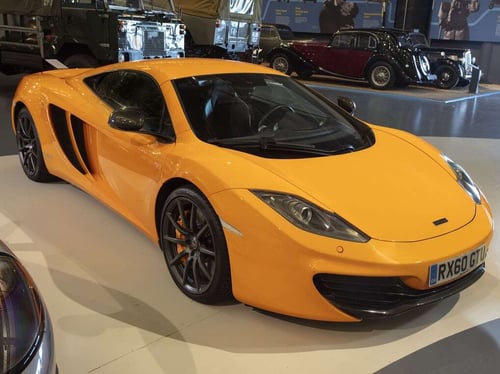
We finish with a McLaren, the only team which Norris has driven for. Lewis Hamilton became Britain’s youngest World Champion with McLaren in 2008, whilst the next year Jenson Button took the crown with Brawn GP, the team reborn from the ashes of Honda Racing. Button joined Hamilton at McLaren for 2010 to form a formidable pairing of the two most recent champions. The pair were called in to help provide input to the development of the MP4/12C, McLaren's first production supercar since the remarkable McLaren F1 of the 1990s. The pair test drove prototype versions at Goodwood in order to provide feedback about how the car drove, providing recommendations which are still prevalent on today’s McLaren road cars. After leaving McLaren, Hamilton went on to win a further 6 titles with Mercedes, becoming the joint most successful driver with Michael Schumacher.
Challenge: Do you have a favourite F1 era, driver or team? Who is your prediction for the 2026 World Champion? Let us know in the comments and share your photos on our social media pages - don’t forget to use the hashtag #ExploringBMM!
The British Motor Museum's goal is to preserve Britain's motoring heritage for future generations to discover and enjoy. Donate now to provide vital support to our work, and help us to collect, conserve, share and inspire.
Tap the button below to contribute.















.png)