
The world's largest collection of historic British cars


The world's largest collection of historic British cars
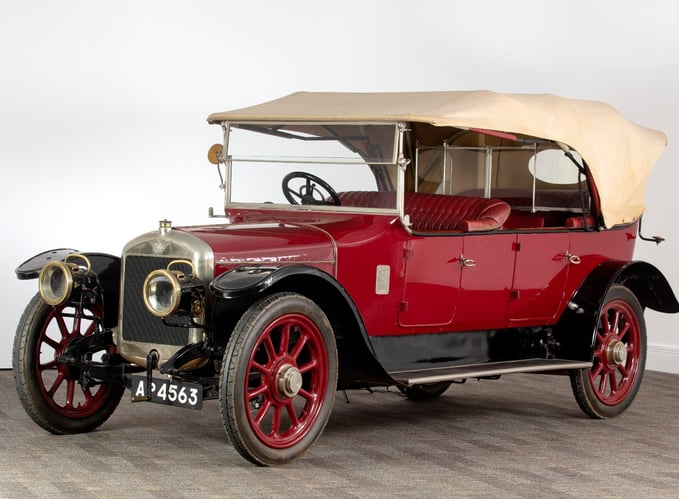
By 1914 Austin was producing over 1,500 premium quality cars a year and the model range had been rationalised to just three models - the 20hp was the company’s mid-sized option.
Almost identical coachwork styles were available on all three models with each body style being given a particular name. It is therefore possible to find a body such as this phæton (meaning an open-top car with no fixed side glass and a folding roof) on any of the models in the Austin range.
This style was considered the height of modernity in 1914 and was described as ‘streamlined’ in Austin’s catalogue. The engine was typical of pre-war Austins; it has separately-cast cylinders and side valves formed in a T-head, with inlet and exhaust valves on opposite sides. Although this was conventional design, the use of full elliptic rear springs that were patented by Austin was rare. Electric lighting and an electric self-starter were offered as extras at a cost of £25 and £30 respectively, although neither is fitted to this particular car.
The 20hp was the only Austin model that was in production throughout the First World War and was replaced in 1919 by the Austin Twenty. This car was originally bought by a doctor from Hawkhurst in Kent, who used it for more than twenty years before donating it back to the Austin Motor Company.















.png)