

[continued]...
I was offered a chance to drive the oldest surviving Rover car along with Trevor Starley. He is the great, great grandson of the founder of both Starley bicycles, John Starley having invented the first “safety” bicycle, and he also started the Rover car company. As an aside, Trevor told me of a letter John Starley received from the Wright brothers asking for investment in their new fangled aerial carriage.
Our steed was a 1904 Rover, registration “P909”. A two seater with a single cylinder of 1300cc and a massive 8hp. One driver suggested that the large 1300cc capacity was near the limit of effort one could reasonably expect to turn over with the starting handle. When running, the sound of the low revving thumping of the single cylinder is quite a sound.
Trevor and I had a training session at the Museum two weeks prior to the L2B and an apprentice, Oliver, patiently explained the intricacies of such a venerable and unique machine. Unusually, for the period, our car had a direct drive instead of a chain, a “floating” chassis and several features which were ahead of its time.
Starting the Rover was quite a complicated technique and required some strength to overcome the compression, but she always started without a fuss.
However, the controls were somewhat eccentric. On the upside, the steering wheel was conventional and not the tiller style used in most early cars. On the downside, it was cable driven, although admittedly having a duplicate cable for safety, and the wheel itself held a rather sticky, rotatable, “Cotton reel” type throttle with serrated teeth for holding a set throttle position. Imagine driving a modern car where you must set the throttle rpm and leave it there for the next part of your journey. The wheel also held the ignition control to advance the engine timing. Forgetting to retard the ignition when using the starting handle, results in a backfire risking a broken arm. Not ideal.
Two of the three floor pedals were a conventional brake and clutch, although the actual braking effect was on a par with that of wishing very hard for the beast to slow down.
The third pedal was the “decompressor”. I understand this reduces the engine compression thereby acting as a basic engine brake. We dabbled with this pedal but it never seemed to do much and we mostly left it to its own devices.
On the training day we learnt to negotiate the Museum carpark with no other traffic, but how would we fare in the real world of the L2B?
We awaited the big day.
The Museum took all six cars to a hotel in London on the Saturday and gave us a room for the night and a reception and briefing in preparation for the Sunday event.
The big day loomed and our first task at 6am was to drive P909 to the starting area in Hyde Park.
Trevor took the wheel and at our first junction a road sign insisted we turn left on to the main road. We needed to go right, so we ignored the sign as traffic was minimal, thereby risking the schedule of escalating fines the L2B organiser can impose for every traffic transgression they spot.
The early morning atmosphere was all that we had hoped for and as one of the youngest cars, built just before the 1905 cut off, we were in Group 11, one of the last of the 400+ cars to start the run, incidentally just a few cars in front of “Genevieve” herself.
I took over the driving at the start line and at 8:15am we were on our way. The iconic section from Hyde Park, over the middle of Hyde Park corner through the Wellington Arch, down Constitution Hill, around Buckingham Palace, along the Mall, through Admiralty Arch, and down Whitehall into Parliament Square was a dream come true. Cheering crowds lined every step of the way and although my driving was tentative and we were passed by many veteran cars, going, in my eyes, hell for leather, it was a fabulous moment I shall always cherish.
The L2B is synonymous with Westminster bridge because of the vital moment in the film Genevieve where the rival Spyker gets diverted by tram lines and Genevieve, minus any passengers, rolls serenely across the bridge to win the prize. If you watch it just ignore the fact that Genevieve is actually rolling over the bridge uphill!
As wonderful coincidence would have it, my timid driving meant that although Genevieve started after us, she had caught us up and passed us over Westminster Bridge. All my Christmases had come at once.
Heading then into South London, the realities of driving a veteran car in modern day London hit home.
Central London had been fine but further South everyday traffic joined us and whilst most modern car drivers were understanding and courteous, a few, no doubt late for Sunday morning footie practice with little Johnny, showed impatience, blowing horns and cutting us up.
One issue is the myriad traffic lights. Occasionally we would get up a little speed in top, ie. third, gear and realise that another traffic light was looming. Given that the gearbox is non synchromesh and very tricky to change from third to second, you have two choices. If you spot the lights in time one method was to slow the car to the minimum speed that third gear will take without stalling and trundle towards the lights hoping that they would change to green as you arrive, alternatively, drive as fast as you can and hope to make the lights before they change to red. A risky policy which can end up with applying all the brakes you can and praying for some friction. I usually took the first approach and sods law often resulted in having to stop completely and drop from third into neutral on arrival at the lights, one second before they changed back to green. Of course, modern car drivers then expected us to move off quickly and that isn’t easy in the Rover. The result was several cars behind us starting to move, then immediately slamming on the anchors having realised that we were going nowhere in a hurry.
Another factor was a rather slipping clutch (leather type, I think), and any attempt to accelerate too fast, especially if the right foot was accidentally resting on the footbrake, resulted in endless revs and little progress. It took several miles to learn a modicum of finesse driving P909 and given the pedal positions it was not easy to hold the right foot away from the brake.
Of course, these cars were designed when it was unusual to meet other traffic on the road and so coping with nose to tail South London traffic, especially in some vicious roadworks we encountered at Clapham, was really tough. But the old girl struggled on and her single cylinder kept pumping up and down determined to reach the coast.
Don’t get me wrong, I had expected and wanted the car to be difficult to drive as I wanted the full Edwardian experience. Originally, I had also wanted the weather to be foul to get the full effect, but after the first couple of miles I realised that just reaching Brighton before the 4pm cut off would be challenge enough. As it happened, we had fabulous weather, warm and dry, but how previous years had coped with cold and damp as well as nursing their cars along, I have no idea.
After a while we pulled over at a church which was a rest stop for several L2B cars and whilst we ran out of time for a cup of tea we did at least give P909 a drink topping up the radiator which had released little puffs of steam whilst sat in the traffic. Out of interest we had help from an adjacent competitor, none other than Andy Green, the fastest man on earth – how the mighty have fallen, eh! Only kidding Andy. Must be fun though to transition from 762mph in a jet car on the Black Rock desert to about 10mph through South London in a veteran car.
Back on the road we next stopped for a belated hot breakfast at a motel near Gatwick, unfortunately arriving just after they had ended the breakfast service. Ever resourceful our BMM admin crew persuaded them to open up again and we tucked in. Although the weather was good you are sat for several hours on top of an old noisy car in traffic in early November and the rest and the food hit the spot.
At the same time the support crew checked P909 over and topped up the fuel and we set off for the coast. By now Trevor was happy to navigate and for me to drive so we trundled onwards through the pretty villages of Surry and Sussex towards Brighton.
The whole route from Hyde Park to Brighton is lined with well wishers smiling, clapping and cheering. We waved back realising how the king must feel. The whole event fosters a feeling of a shared community for the whole route, including drivers, support and admin crews, organisers and spectators.
Several small villages were holding classic car events to mark the L2B and the whole route, once out of London, had a party atmosphere all the way to Brighton. We stopped at the pretty village of Staplefield, which was hosting a car rally on its lovely common. Quickly, a crowd gathered around the Rover, full of questions, which we answered as best we could. Had they known what little experience we really had, they may not have accepted our answers so readily.
Those who cross the finish line before 4pm receive a finishers medal and we always had this in mind during our brief stops. Nearing Brighton with eyes on the clock, terrified of any last minute breakdowns, we pushed on towards the sea, sadly passing a couple of cars, clearly struggling to make the last couple of miles.
In Brighton itself I messed up several gear changes, grinding to a halt and holding up the traffic, probably over excited with the finish so close.
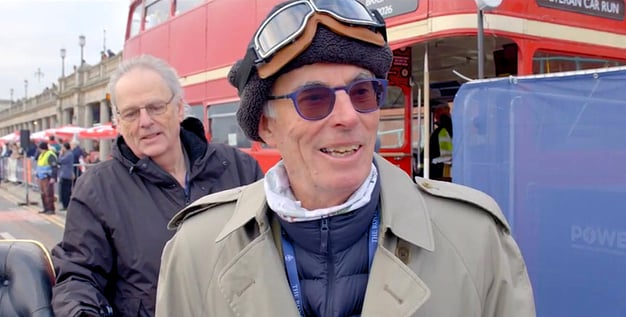
Finally, Madeira Drive and the seafront hove into view and we made it to the finish line. We felt relief, joy and exhaustion in equal measure as we drove the last few hundred yards, waving at the hundreds of spectators and madly blowing our horn, surprisingly deep and sonorous for such a little car. We were even stopped for a little interview with the finish line commentator.
I hadn’t expected any friends or family to make it to the finish but the final joy as we came to a halt was the sight of my good friend, Nick, who had flown back from Venice the evening before and kindly driven 2hrs each way from our home town of Poole harbour, in order to cheer us over the line. A nice gesture.
Parking up amongst the finishers gave a real sense of achievement and the Museum admin and support team were there to see us home. Well done, guys, we couldn’t have done it without you.
Trevor and I had crossed the line at 3:15pm and thereby won the finishers medal. We decided that Trevor would keep a bronze plaque and I’d keep the medal which sits proudly on my desk. It had taken seven hours to drive the 60miles at an average speed of a stately 8.5mph.
Complimentary food and drink was provided by the organisers for all the finishers and that was gratefully received.
Overall impressions?
Firstly, I’m in awe at the fortitude of the original owners of these lovely cars. Edwardian motoring was a real trial of endurance and ingenuity. A run to Brighton, in all weathers, must have been the equivalent of us driving from London to Instanbul today in a Caterham.
Secondly, the constant crowds lining the route spurred us on and they made the day so special.
Finally, the British Motor Museum staff organised our participation in the event superbly and everything went to plan thanks to their years of experience in hosting these rides in their fabulous cars.
Would I do it again? Just try and stop me.
To find out more about the British Motor Museum please visit the website at www.britishmotormuseum.co.uk. For more information on the London to Brighton Veteran Car Run please visit www.veterancarrun.com