

Our conservator, Cath, shares progress on one of our ongoing projects to rehouse many of the Archive's technical drawings.
How we store our collections is one of the most important factors to be considered when preserving material for future generations to use and enjoy. Incorrect storage can have a huge impact on materials, leading to degradation and in some cases, complete loss. Here in the archive, we are currently planning and undertaking a number of projects in order to ensure that storage methods are upgraded to provide the best possible environments for all of our historic material.
One of our main areas of focus recently has been the drawings and posters of which the archive holds a substantial amount. Before the project began, flat and rolled format drawings were being stored together in drawers and on shelves, which as a result, was causing tearing and deterioration. Other drawings were covered, but piled up on shelving made from MDF, which is very much considered inappropriate for use in storing archive materials.
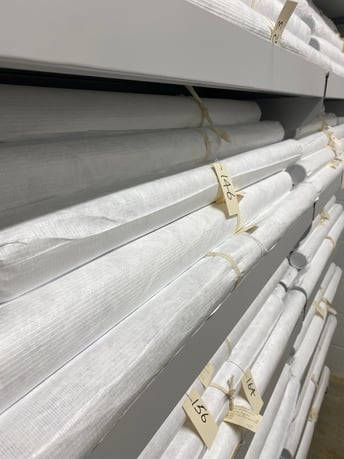
It was decided that the MDF racking should be taken down and replaced with something more appropriate to house the rolled drawings safely and so a dedicated racking system was chosen to replace it. Once in place, the next task was to separate, clean, repair where needed, wrap, and catalogue all of the drawings. This was going to be no mean feat – thousands of drawings would need to be processed, taking a lot of time and resources.
To begin with, we had to decide on the best way to wrap the drawings; storing this many drawings together could cause crushing, so to reduce the risk of this, we needed to create a solid core to wrap them around.
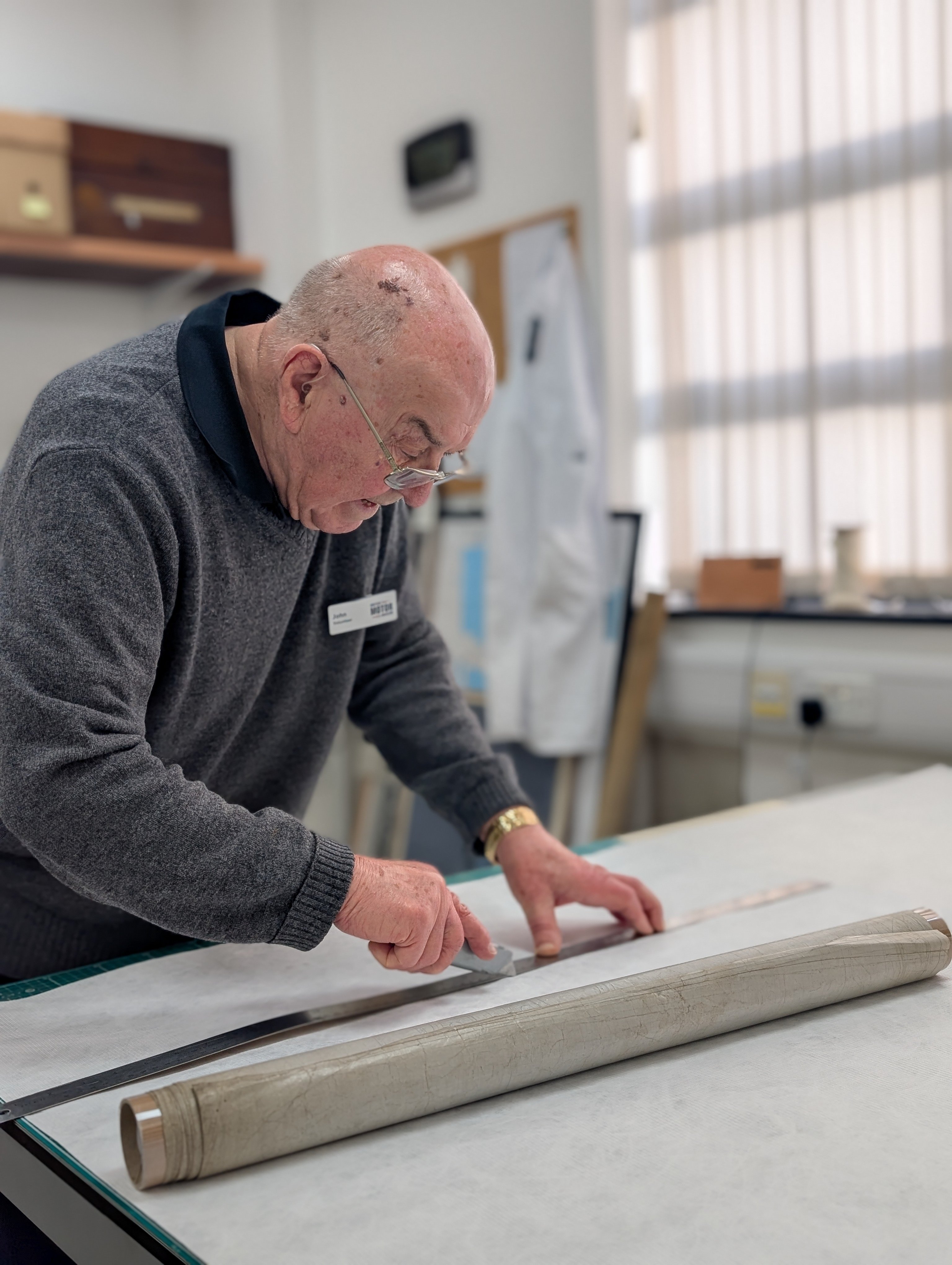
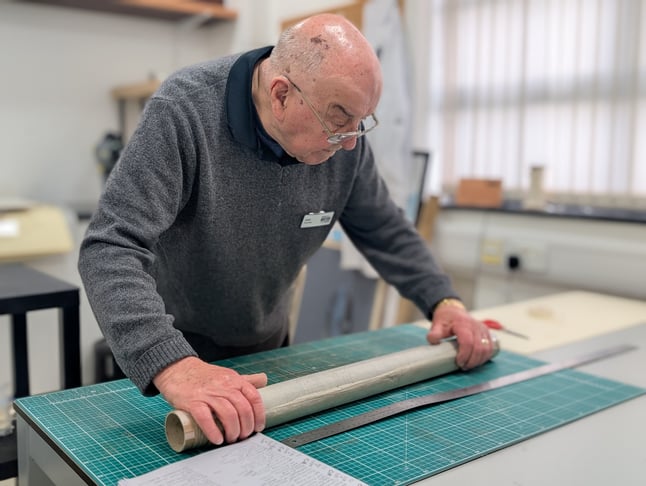
Acid free options would have been the perfect solution, but also a very expensive one due to the number of drawings we needed to wrap. We opted for cardboard postal tubes which we then covered with polyester sheeting to protect the drawings. The polyester is an inert material and would create a buffer between the cardboard and the drawings. These ‘cores’ were perfect for rolling the drawings around, enabling us to then wrap them in Tyvek© sheets to protect them from dust and other airborne pollutants.
A solution for the rolled drawings had been found, but now we needed one for the flat drawings. These also needed rehousing and with each draw containing hundreds, the first thing we needed to do was to split them down into manageable sections. Even though the drawings are very thin, they do weigh quite a bit and can be slippery to move when several of them are stacked together; this can make them difficult to move without causing damage. We needed a way to make them easier to retrieve and move, so after breaking them down into sections, we started creating new folders out of acid free card. Linen tapes were placed on the three open sides to help keep everything safe inside. The other problem was that some of the drawings were incredibly dirty and needed to be cleaned. This ongoing project is being carried out in the conservation studio using a special cleaning powder. It is quite a painstaking process, but very gentle and quite effective. After cleaning, the drawings are ready to be rehoused in their new folders.
Finally, we couldn’t carry out these projects without the help of our wonderful volunteers. John Sheffield has been dedicating nearly all of his time with us to working on the drawings and has managed to take a chunk out of the huge amount of rolled drawings to process. Thank you, John, for what we’re sure has been a rewarding, but sometimes monotonous job!
Although we still have a long way to go to finish the project, every wrapped drawing is a step closer to a useable and safely preserved collection that will be enjoyed for years to come.















.png)