
The world's largest collection of historic British cars


The world's largest collection of historic British cars
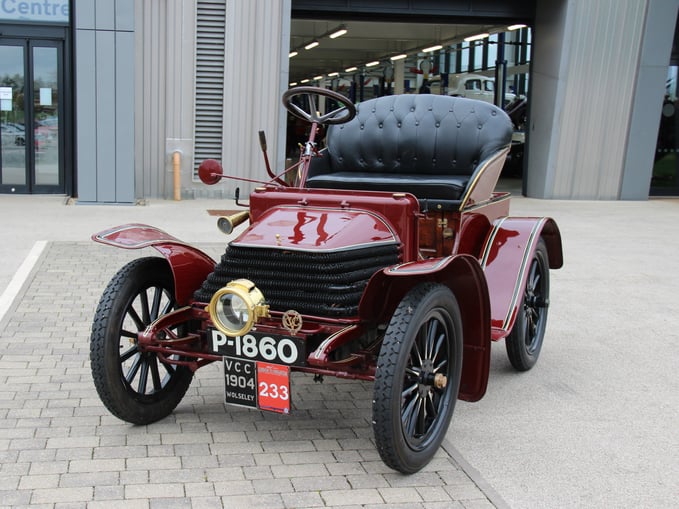
This car is an early production model of one of Wolseley’s last products before Herbert Austin left to found the Austin Motor Company in 1905. Only about eight other examples are known.
Disagreements over the design of production cars between Austin and Wolseley’s automobile management, taken over by Vickers, Sons & Maxim in 1901, came to a head not long after the introduction of Austin’s last model for the company - the 6hp.
Austin’s preference for horizontal transverse engines cooled by the distinctive gilled tubes that wrap around the front - a Wolseley feature - was soon discarded after his departure. His replacement, John Davenport Siddeley, who Vickers, Sons & Maxim had already made an alliance with in 1903, favoured vertical engines and soon started to produce these cars exclusively.
Unlike Wolseley’s other models, the 6hp was assembled in the Vickers, Sons & Maxim factory at Crayford in Kent. At the time, the sister company Siddeley produced an almost identical car in the same factory, although characterised by a more traditional radiator – a veteran form of badge engineering!
The car has a chain drive to the rear, with rear braking comprising friction belts binding on the rear axle. Steering is by worm and wheel, and the horizontal engine is fed by gravity from the tank and controlled by a hand-operated throttle. The clutch and brake pedals are reversed, with the clutch on the right and the brake on the left.















.png)