
The world's largest collection of historic British cars


The world's largest collection of historic British cars
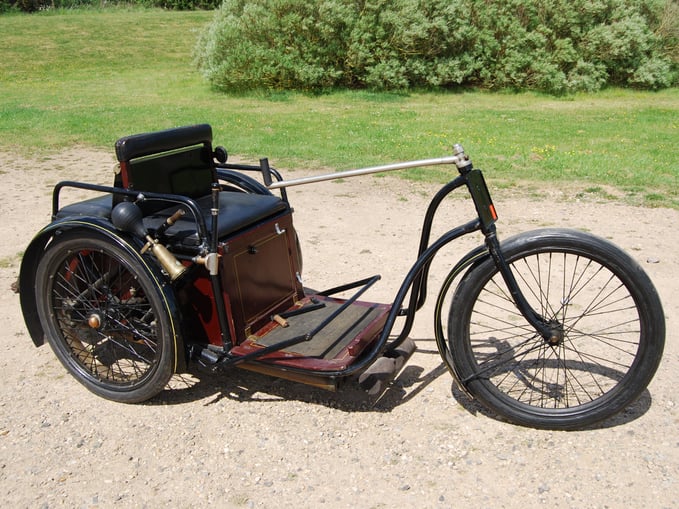
One of Herbert Austin’s early vehicle designs for Wolseley, this tricar was favourably reviewed but despite advertising, there was not enough interest and no more models were made.
Two years after its first appearance at the National Cycle Show at the Crystal Palace in December 1896, Austin drove ‘Autocar Number One’ 250 miles from Birmingham to Rhyl and back, which was remarkable for an early car.
Before this journey, the original twin-cylinder engine underneath the seats was replaced with a single-cylinder unit mounted horizontally and mostly made from bronze for ease of casting. The cooling spikes on the cylinder head look like a torture instrument!
The frame is constructed from steel tubes rather like a bicycle and although there is no suspension on the front wheel, the rear has spring radius rods; a very early use of independent suspension. There are two pairs of brakes, one operated by a foot pedal and one by hand, both acting internally on the rear wheel rims. Ignition is by a spark plug and trembler coil and two speeds were available using belts on fixed and loose pulleys. A foot and hand brake both act internally on the rear wheel rims.
Austin’s next project for Wolseley was the more successful four-wheeled Voiturette, the prototype of which is in the Museum’s collection.













.png)